
When Your Body Is Telling You Something Is Wrong: My Story of Cauda Equina Syndrome
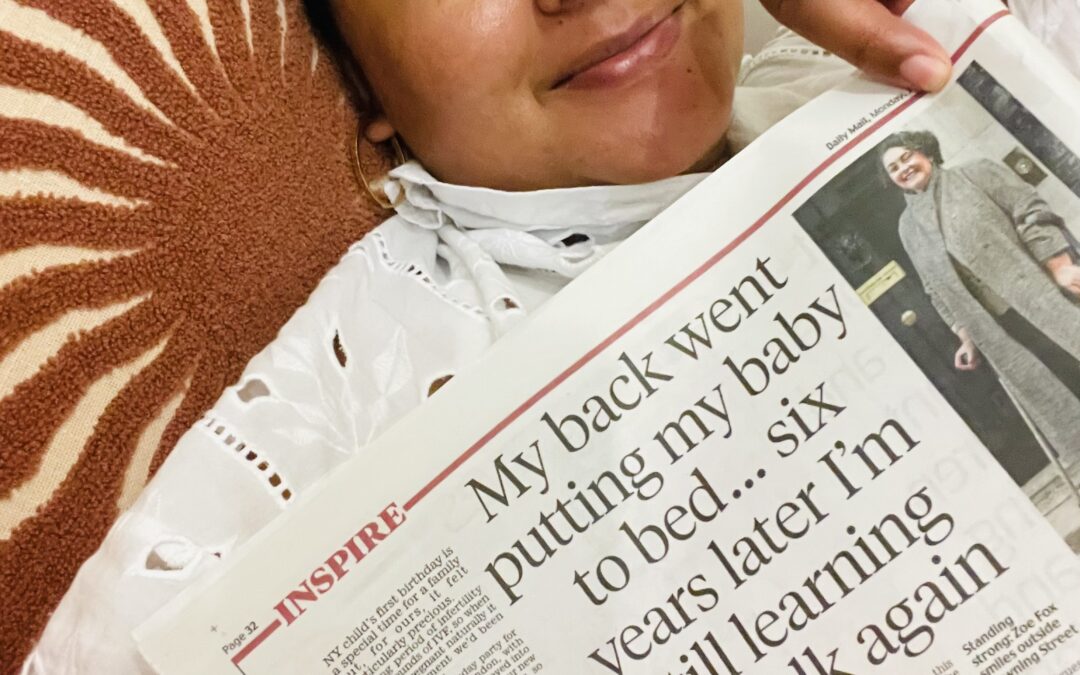
Featured in the Daily Mail, 6 July 2026
There are some stories you never imagine you’ll find yourself telling. And then life has other plans.
In July, I found myself sharing a very personal part of my life in the pages of the Daily Mail. The story of how a seemingly ordinary backache left me paralysed, and how, six years later, I’m still impacted.
Seeing my story in print was surreal. An old friend messaged me that morning to say they’d spotted me in the paper, and for the first time in as long as I can remember, I bought a newspaper.
But beyond the novelty of seeing my face and words in print, I hoped that sharing my experience might help someone recognise the signs that something isn’t right with their body, find the confidence to speak up, or feel a little less alone in what they’re going through.
Because I know what it’s like to feel that something is wrong and struggle to get the answers you need.
When a backache becomes something much more serious
In February 2020, I was a new mum, navigating life with a young daughter, when I began experiencing back pain.
I was 36, and although I’d experienced back problems before, something about this felt different. I sought medical advice, but I had no idea just how serious things were about to become.
Within days, I found myself paralysed below the waist when I went to step out of a taxi on my daughter’s 1st birthday, and that day my life changed in a way I could never have imagined in a million years.
An emergency MRI revealed a medical emergency. I needed urgent surgery and was diagnosed with Cauda Equina Syndrome, a rare but serious condition in which the nerves at the base of the spinal cord become compressed.
I underwent emergency surgery, but some damage had already been done.
I had sustained a spinal cord injury, leaving me with lasting changes to my mobility, bladder and bowel function, alongside chronic pain and other complications.
I remember being told that I would need to learn to walk again and use the toilet again at the same time as my 1-year-old. It was an enormous amount to process, particularly as I was trying to understand what this meant for my future and for the kind of mother I would be able to be.
There is no neat way to describe what happens when the life you recognise disappears almost overnight. You’re left trying to make sense of something you never asked for, while somehow finding the strength to navigate the practical, physical and emotional realities of your new circumstances, in a global pandemic no less.
The importance of listening when something doesn’t feel right
One of the reasons I wanted to share my experience publicly was to raise awareness of Cauda Equina Syndrome.
The symptoms can be frightening, and recognising them early matters because delays in assessment and treatment can lead to permanent nerve damage.
Symptoms that require urgent medical assessment include new numbness around the saddle area (the groin, genitals or buttocks), changes in bladder or bowel function, new sexual dysfunction, severe or progressive weakness in the legs, and symptoms affecting both legs.
These symptoms do not always occur together, and you should not wait for every symptom to appear before seeking help.
If you experience these warning signs, seek emergency medical care immediately!
I had no idea that what I thought was a backache could be a sign of something so serious. I so wish I’d understood more about the condition back then, and I can only hope that by sharing my experience, someone else might recognise the warning signs sooner.
This isn’t about encouraging people to assume the worst whenever they experience pain. It’s about understanding our bodies, taking changes seriously and knowing when something needs urgent attention.
It’s also about recognising that we know our own bodies in ways that can be difficult to communicate to someone else.
But when something feels different, persistent or increasingly concerning, you deserve to have those concerns taken seriously. Trust yourself; you’re the expert in your body.
When you’re not being heard
My experience of navigating the healthcare system has been complicated.
Long before my Cauda Equina Syndrome diagnosis, I had spent years experiencing problems with my legs. I was even told by a consultant that I did not present with signs of lipedema, years before I was eventually diagnosed with lipedema at 41. After living with symptoms for decades and being told to lose weight, I always sense that they were wrong in the rejection of my diagnosis.
For years, I didn’t have the language or the diagnosis to explain what was happening in my body. Like many women, I found myself questioning myself and trying to make sense of symptoms that weren’t being adequately explained.
When you repeatedly raise concerns and don’t receive the answers you need, it can begin to affect your relationship with yourself. You might question whether you’re overreacting, whether you’re explaining yourself properly, or whether you should simply learn to live with what you’re experiencing.
And that is a difficult place to find yourself.
I know how exhausting it can be to keep asking for help when you’re already struggling. It takes energy to advocate for yourself, especially when you’re unwell, frightened or trying to hold everything together for the people you love.
I also recognise that healthcare professionals have difficult jobs and that not every situation has a straightforward answer. But people deserve to be listened to, their symptoms investigated appropriately, and their concerns taken seriously.
Awareness matters because understanding a condition can change how we interpret our experiences, how we seek support and how we advocate for ourselves.
It’s one of the reasons I have more to say about lipedema, too. So many women spend years blaming themselves for symptoms they don’t understand. We need more awareness, better understanding and more compassionate conversations about women’s health.
Learning to live in a body that has changed
Six years on, I’m still learning what life looks like after spinal cord injury.
I live with neuropathic pain, fatigue and changes to my bladder and bowel function. There are things I once did without thinking that now require planning, energy and consideration.
And there are days when that is difficult to accept.
I don’t share this to invite sympathy or to suggest that I’ve somehow mastered the art of living with disability. I haven’t. I’m still figuring it out.
There have been times when I’ve struggled to understand what has happened to me, why my body has changed so profoundly, and how to reconcile the life I imagined with the life I’m actually living.
But there have also been moments of deep learning.
Through rehabilitation, counselling, journalling and connecting with other people living with spinal cord injuries, I’ve gradually begun to find ways to process my experiences rather than simply push them down.
I’ve had to learn that my worth isn’t measured by how much I can do in a day, how independently I can move through the world or how closely my life resembles the one I had before.
That has been a much deeper lesson than I ever expected.
I’m a mom. I’m an author. I’m a woman with ambitions, ideas and things I want to contribute to the world. I’m also a person living with disability, navigating pain and learning to accept that some days my body simply needs something different from me.
All of those things can be true at once.
And perhaps that is one of the most important things I’ve learned: we don’t have to deny the difficult parts of our experiences to acknowledge that there is still life, meaning and possibility within them.
Why I keep sharing my story
Writing and sharing my experiences has become an important part of how I make sense of my life.
My book, Activate Your Light, explores healing, self-discovery and the process of reconnecting with ourselves. Much of what I write about comes from my own journey of learning to meet life differently when things don’t unfold as I expected.
I don’t believe that every difficult experience arrives with a lesson neatly packaged inside of it. Some things are just painful, unfair and bloody hard.
But I do believe that, with the right support and space to process what we’ve been through, we can find new ways of relating to ourselves and our lives.
Sometimes that begins with something as simple as putting words to an experience we’ve carried internally for years.
Sometimes it’s discovering that another person has been through something similar and realising we’re not the only ones.
And sometimes it’s learning to trust ourselves again after years of feeling unheard.
That’s what I hope comes from sharing my story in the Daily Mail and in the work I continue to do.
If even one person recognises a warning sign and seeks urgent medical help, if one woman living with unexplained symptoms feels less alone, or if someone navigating a life-changing diagnosis feels a little more understood, then sharing these parts of my life feels worthwhile.
Because our stories are not just the things that have happened to us. They are also the ways we make sense of those experiences, connect with other people and help create understanding where there may once have been none.
And if there is one thing I would want you to take away from mine, it is this:
Listen to your body. Trust yourself enough to ask questions. And don’t be afraid to keep seeking answers when something doesn’t feel right.
You deserve to be heard. You deserve support. And you deserve the opportunity to understand what’s happening to you.
Sometimes, advocating for yourself is one of the most important things you can do for your future self.